Septembre 2025
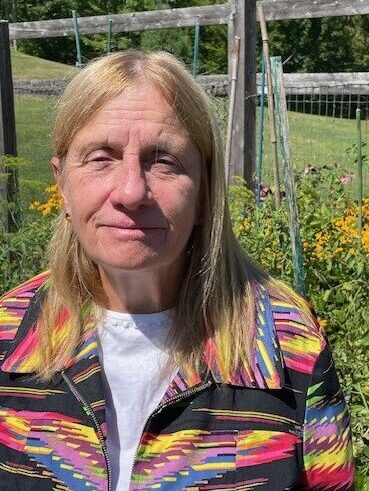
Family physician for over 40 years, Dr. Renée Fournier has practiced across the entire healthcare network—from the heart of Montréal to rural Ontario, and even on a humanitarian mission in Africa. Emergency physician, hospitalist, teacher, and pioneer of interdisciplinary work, she has always chosen to dive in, learn, and commit.
Now transitioning toward retirement, she still practices at the Queen Elizabeth GMF-U and continues to share her knowledge with passion. "Family medicine is not a linear career. You can’t expect to know everything from day one. But if you dive in, you’ll learn. And you won’t regret it!"
From a working-class background—her father was a mail carrier, her mother a seamstress—Dr. Renée Fournier had no doctors in her family to inspire her.
"I wanted to be a vet my whole life. I loved animals—still do!" she recalls.
While studying biology, she worked weekends and summers in the cardio-respiratory lab at Hôpital Sacré-Cœur, taking blood samples for arterial blood gas and carbon monoxide levels. She was often called to the ER or ICU for the most critical cases. "They were always calling me for the big cases—intubated patients, ICU... That’s where I discovered medicine."
After finishing her bachelor’s, she applied to both medicine and veterinary school. Her interview in medicine went so well that she got the call just hours later.
"They said, ‘You’re in.’ I said yes immediately. I’ve never regretted it."
From the very beginning of her career, Dr. Fournier gravitated toward frontline medicine— fueled by human connection and adrenaline. She completed a family medicine residency, even before it was mandatory, motivated by her interest in emergency care, obstetrics, and pediatrics. “I wanted more electives so I could work in rural settings and be versatile.” She then worked in the Verdun emergency room, in a CLSC, and took part in the Urgence Santé program, back when physicians would travel with paramedics by car. " We’d intubate, administer Narcan, stabilize patients on site… Murders, overdoses, fires, bad car accidents—I’ve seen it all. It was fascinating."
Driven by a shared professional commitment, Dr. Fournier and her partner—a medical specialist—moved to Ontario, where he pursued clinical research and a fellowship in maternal-fetal medicine. What was meant to be a temporary detour eventually led them to settle in London, Ontario, in 1985… and stay for 25 years.
In Strathroy, she discovered a rural practice that was both diverse and deeply human. She worked in a small community hospital with a very high volume of outpatient care. Family doctors there looked after their own hospitalized patients, assisted in surgeries, took emergency shifts, and some delivered babies.
"Back in the 80s and 90s, we admitted under our own names. There were no full-time orthopedists or pediatricians—you had to be ready for anything."
She joined a Family Health Team model, where physicians worked closely with nurse practitioners, pharmacists, psychologists, and social workers.
She developed a strong interest in maternal and child health, as well as home care. "In many families, I cared for up to four generations. It was that old-school family doctor model—but not so old, just rural. It was incredibly rewarding."
True to her values, she also served as a peer assessor for the College of Physicians and Surgeons of Ontario, visited French-speaking clinics as far as northern Ontario, and sat on several hospital committees. "We weren’t paid, but we learned so much. I loved seeing how other clinics operated—it helped us bring the best practices back to our own GMF."
When the time came to return to Québec, it took over a year to transfer her 1,500 patients. "It was a real loss. Some of the babies I had delivered were pregnant themselves when I left! These were very special relationships."
In 2010, upon returning to Montreal, Dr. Fournier joined the Queen Elizabeth GMF-U, drawn by its transition to electronic medical records and its academic teaching environment. She quickly noticed a significant gap in obstetric and pediatric follow-up for patients. She initiated a partnership with a McGill-affiliated hospital to provide prenatal care up to 36 weeks and then resume postnatal follow-up. The outcome was transformative: a wave of newborns reshaped the clinic’s pediatric culture. "I'm really proud of that. We trained our nurses in vaccination and set up dedicated baby clinics. When there are children, there’s life and joy in a clinic!"
Since then, she has passed on her experience to young residents. Her message is clear: "Dive in. Be curious. Don’t try to be an expert in every specialty. You’ll learn by doing." She promotes versatility, resourcefulness, and emphasizes the importance of preserving physicians' mental health. "Take care of yourself before you take care of others. Learn to delegate, to set boundaries. If you don’t have time to clean your house, hire someone. Spend that time with your kids instead."
On the verge of retirement, her curiosity remains intact: she wants to explore artificial intelligence, test tools like Scribd to reduce paperwork, and continues to advocate on public health issues like vaccination. "When I was a student and then a resident, we still saw — far too often — cases of meningitis caused by Haemophilus influenzae or meningococcus. Today, thanks to vaccines, many young doctors have never seen a case. And that’s a good thing. We need to keep talking about vaccination, offer it on site, and actively fight misinformation."
In her 42 years of practice, Dr. Fournier has managed to preserve a precious balance between professional commitment and personal life. Today, she splits her time between Montreal and her retreat at Lake Massawippi, where she tends a vegetable garden, a blueberry patch, and dwarf apple trees. Between cycling, skiing, tennis, traveling, and culinary projects — like taking fine pastry classes with colleagues approaching retirement — she keeps herself plenty busy.
“I have so many projects!”
In 2020, just before the start of the pandemic, she took part in a humanitarian mission in Congo-Brazzaville with her husband and the organization Terre Sans Frontières. Together, they provided care to refugee populations, especially in maternal and child health. “It was a shock. Women give birth using an oil lantern, there’s no blood bank, no vaccines... It’s maternity care with no prenatal care at all.” Her husband performed an emergency C-section using intravenous ketamine. She came back deeply shaken but determined. “It’s a failure of our planet that we can’t do more for these people. But we helped train a young Congolese doctor and financed a more modern ultrasound machine. That’s what makes a real difference.” She’s already considering repeating the experience in retirement.
Today, she strives to pass on that sense of balance to her colleagues and residents: protect your mental health, enjoy time with your family, and make room for leisure. “When the kids were in ski competitions, I was a volunteer parent on the slopes. Everyone was outside, everyone enjoying the day. We spent time together as a family.” And when everyday life threatens to overflow, her advice is simple: “Delegate what you can. The cleaning can wait. The time with your kids — that doesn’t come back.” For her, medicine is a calling… but personal life should never come second to everything else.
